

Newsroom
Sustainable funding schemes required to preserve European capacity for AMR and TB Research & Development
The threat of antimicrobial resistance (AMR) and tuberculosis (TB) looms large over global health. A coalition of nine European initiatives, including the UNITE4TB Consortium, has emphasized the critical need for sustained investment in antibiotic and TB research and development. The call to action, published in Nature Reviews Drug Discovery, underscores the urgency of maintaining expertise and capabilities to develop new treatments for TB and other infectious diseases.
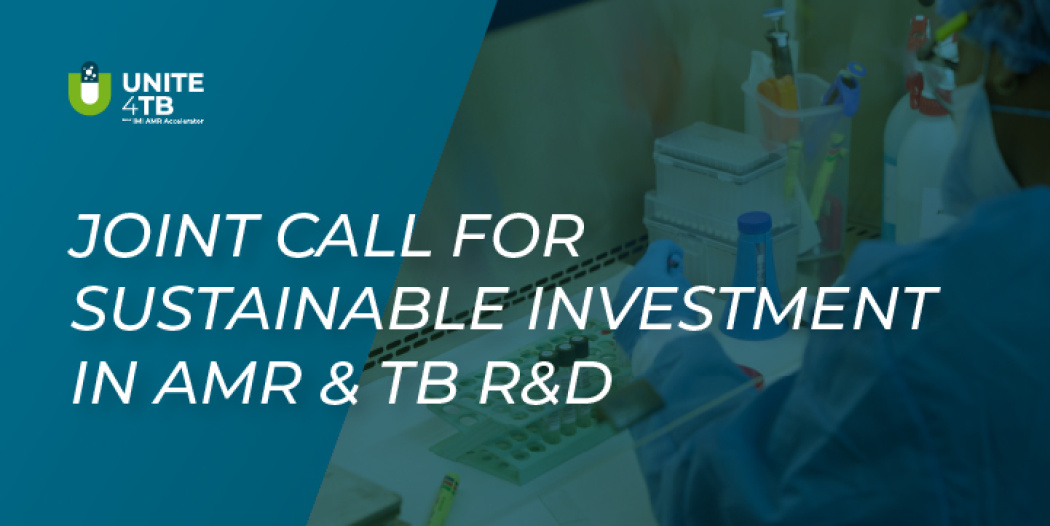
Together, these nine projects – all part of the AMR Accelerator funded by the Innovative Health Initiative (IHI) – call on government leaders, the private sector, and other stakeholders to invest in the development of new antibiotics and research on AMR, to secure a sustainable future for large-scale efforts.
“Within the AMR Accelerator, UNITE4TB stands out with its emphasis on TB research and development,” said Dr Derek Sloan, UNITE4TB coordinator from the Radboud University Medical Centre & the University of St Andrews, and co-author of the Nature Reviews Drug Discovery publication. “As with the other AMR Accelerator projects, UNITE4TB’s mix of partners from industry, academia, and SMEs not only enhances the project’s capabilities but also challenges existing approaches, leading to optimized efforts.”
AMR is one of the greatest global challenges of our time, undermining healthcare systems that rely heavily on antibiotics to prevent and treat infections. The pressing need for new antibiotics will be highlighted at the United Nations General Assembly High-Level Meeting on AMR on 26 September. However, the low return on investment in this area has driven many large pharmaceutical companies to abandon the field, resulting in a significant decline in the development of new drugs and therapies for bacterial infections.
According to the authors of the Nature Reviews Drug Discovery call to action, collaboration and risk-sharing are key to retaining companies in anti-infective drug development. Public-private partnerships like UNITE4TB and the other AMR Accelerator projects allow different organizations to share risks and costs. These long-term collaborative efforts build expertise and capacity for antibiotics research and development. However, without continued investment, there is a risk that the new generation of experts trained across the AMR Accelerator projects also leave the field.
Speaking on how UNITE4TB has benefitted from the AMR Accelerator, Dr Sloan said: “From the perspective of UNITE4TB, the AMR Accelerator provides an unprecedented opportunity to design and run clinical trials with ambitious innovative designs to identify the best combinations of drugs for late-phase evaluation. The breadth and scale of the work we can now undertake should shorten the time needed to find new, more effective treatments for tuberculosis. The need for such progress has never been greater, as the global specter of increasing drug resistance grows within a disease where the range of options for clinicians and patients remains too few.”
The AMR Accelerator projects have received funding from the European Commission via the Innovative Medicines Initiative (now IHI) and pharmaceutical companies that are members of the European Federation of Pharmaceutical Industries (EFPIA). With a total budget of €479 million, the AMR Accelerator has progressed 44 antibacterial programs over the past five years. So far, the effort has resulted in 16 preclinical and clinical candidates, two completed Phase I studies, and five ongoing Phase I and II studies. The continued success of the AMR Accelerator demonstrates the value of public-private partnerships in replenishing the antibiotics pipeline and providing tools and infrastructure for the global research community.
The AMR Accelerator has created critical mass and synergies that have allowed the transfer of assets, knowledge, and expertise between projects. The results are tangible: better and more efficient science, a strengthening of the antibiotic pipeline, and a legacy of research infrastructures that can support the global fight against antibiotic resistance. These include, standardized infection models, clinical trial networks, open data resources, and more. The key challenge for all nine projects is to ensure the long-term sustainability of assets, infrastructure and expertise. This, in turn, requires a commitment from governments and the pharmaceutical industry to long-term investment in antimicrobial research and antibiotics development.
The call to action was published in the comment section of Nature Reviews Drug Discovery. The text can be freely accessed from the journal’s website between 23 September and 6 October 2024: The AMR Accelerator: from individual organizations to efficient antibiotics development partnerships.
To access the article after 6 October without a subscription, please go to the AMR Accelerator website.
Cite as: Fernow J, Olliver M, Couet W, Lagrange S, Lamers MH, Olesen OF, Orrling K, Pieren M, Sloan DJ, Vaquero JJ, Miles TJ & Karlén A, The AMR Accelerator: from individual organizations to efficient antibiotic development partnerships, Nature Reviews Drug Discovery, DOI: 10.1038/d41573-024-00138-9
About the AMR Accelerator
AMR Accelerator programme was launched in 2019, with the aim to accelerate the development of medicines for patients suffering from infections with drug-resistant Mycobacterium tuberculosis, Nontuberculous mycobacteria (NTM), and Gram-negative bacteria, and build capability for antibiotics research and development. The programme is funded by the Innovative Medicines Initiative (IMI). The AMR Accelerator programme includes nine projects: AB-Direct, COMBINE, ERA4TB, GNA NOW, PriMAVeRa, RespiriNTM & RespiriTB, TRIC-TB, and UNITE4TB. Together, the projects have a €479 million budget. The 98 partners represent key stakeholders from academia, industry, small- and medium-sized companies, patient organisations, regulators, and Health Technology Assessment.
IMI projects are public-private partnerships, funded in equal parts by the European Union’s Horizon 2020-programme and the pharmaceutical companies that are members of EFPIA.
More information: www.amr-accelerator.eu
AMR Accelerator portfolio: https://amr-accelerator.eu/amr-accelerator-project-portfolio/
The AMR Accelerator has received funding from the Innovative Medicines Initiative 2 Joint Undertaking under Grant Agreements No 853967 I 853989 I 853979 I 853932 I 853800 I 853903 I 853976 I 101007873 I 101034420. This Joint Undertaking receives support from the European Union’s Horizon 2020 research and innovation programme and EFPIA. ERA4TB receives additional support from Global Alliance for TB Drug Development, Bill & Melinda Gates Foundation and University of Dundee. UNITE4TB receives additional support from Deutsches Zentrum für Infektionsforschung e. V. (DZIF), and Ludwig-Maximilians-Universität München (LMU). EFPIA/AP contribute to 50% of funding, whereas the contribution of DZIF and the LMU University Hospital Munich has been granted by the German Federal Ministry of Education and Research.
Disclaimer: This text reflects the author’s view. Neither IMI nor the European Union, EFPIA or any Associated Partners are responsible for any use that may be made of the information contained herein.